
Peak-End Rule
Concept: Vocabulary that names a phenomenon.
Kahneman’s finding that the remembered quality of an experience is dominated by its most intense moment and its end, with the duration of the rest largely neglected.
Where the name comes from: Daniel Kahneman and three co-authors reported the regularity in Psychological Science in November 1993. “Peak-end” is shorthand for what they named more precisely as the retrospective evaluation of extended outcomes by a peak-end average. The phrase has since slipped into customer-experience copy as a permission slip for “end on a high note,” usually without the duration-neglect half of the finding or the caveats the literature has accumulated since.
Definition
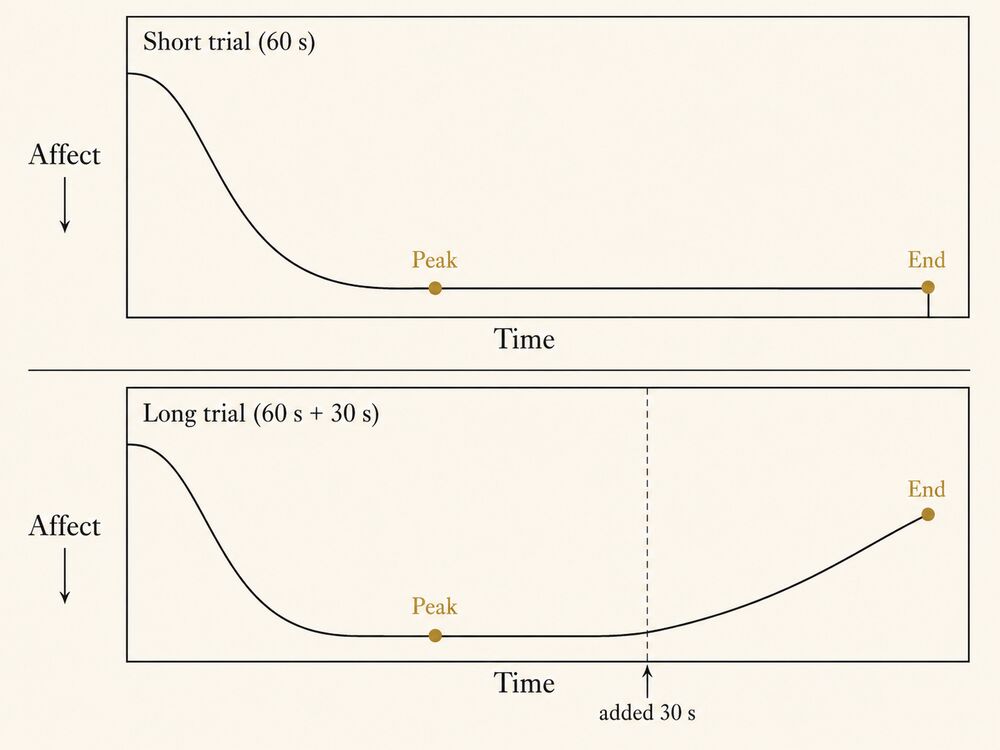
The remembered quality of an extended experience is predicted, with surprising accuracy, by the average of two anchor points: the most intense moment (the peak) and the final moment (the end). Everything in between contributes little, including the duration. The rule was reported in Kahneman, Fredrickson, Schreiber, and Redelmeier, “When More Pain Is Preferred to Less: Adding a Better End,” Psychological Science (November 1993), Vol. 4, No. 6, pp. 401–405. The companion finding is duration neglect: length barely registers in the retrospective summary, even when the difference is large.
The cleanest demonstration is the paper’s cold-pressor study. Subjects held a hand in painfully cold water for 60 seconds (short trial), then in a separate trial for 60 seconds at the same temperature plus 30 seconds during which the water was raised to a slightly less painful but still uncomfortable temperature (long trial). The long trial contains every second of pain in the short plus 30 more. Asked which trial they would prefer to repeat, a majority chose the longer one. The choice is locally irrational by any theory respecting a strictly-worse interval. It makes sense only if the remembered quality is something close to the average of peak and end intensities; the long trial, whose end was milder, wins on the summary that drives the choice.
The result has held up across heterogeneous settings. Redelmeier and Kahneman replicated it clinically in “Patients’ Memories of Painful Medical Treatments,” Pain (July 1996), Vol. 66, Nos. 1–2, pp. 3–8: extending a colonoscopy by a few minutes of lower-intensity discomfort at the end produced better remembered evaluations and a measurable lift in willingness to return for follow-up screening. Meta-analytic work has confirmed the shape across vacations, music listening, sports outcomes, and consumer-service encounters, with the clearest signal in experiences of moderate length and a single dominant valence (Cojuharenco and Ryvkin, “Peak–End Rule versus Average Utility,” Journal of Mathematical Psychology (2008), Vol. 52, No. 5, pp. 326–335; surveyed in Geng et al., 2013, and updated in a 2022 piece in the Journal of Consumer Psychology).
The rule is not a claim that the experiencing self is irrelevant. It is a claim about the remembering self, the one that books the next visit, writes the review, and tells the friend. That self compresses an extended experience into a single number, dominated by two anchor points.
Why It Matters
Peak-end is the most actionable cognitive finding in experience design. Three things change once it enters the brief.
The budget. Distributing a fixed budget of attention, money, staff training, lighting, scent, and choreography evenly across a duration is the wrong loss function. The same spend buys more remembered quality if it concentrates on the peak and the end. The Cornell Hospitality Quarterly and Journal of Service Research literature on guest-experience interventions converges on the same conclusion: a signature culinary course, a recognition gesture, an architectural reveal, a memorable departure, a hand-written note. These outperform the same money spread thin.
What the operator measures. Real-time pulses and in-app ratings sample the experiencing self; retrospective surveys and net-promoter scores sample the remembering self. The two will disagree, often sharply, on the same trip. Peak-end predicts the shape: remembered ratings track peak and end; in-the-moment ratings track the running average. An operator who measures only one is missing half the picture.
The shape of the brief. The goal stops reading “a great hotel stay” and starts reading “a stay whose remembered curve has a strong third-day peak (signature dinner at the rooftop) and a strong end (driver-assisted send-off, hand-written note in the car), with operational consistency in between sufficient to hold the average above a defensible floor.” The peak and the end can be observed; the floor can be operationalized; the budget allocation has a defensible logic. Peak-End Composition, Farewell as Peak, the Trophy Artefact, and the Shareable Moment are the patterns that take the finding into practice.
How It Shows Up
Three cases at three settings and three price tiers.
Disneyland’s “kiss goodnight” closing sequence (Walt Disney Imagineering; original instruction from Walt Disney in 1955, ritual codified in the late 1990s). The closing fifteen minutes are choreographed as an engineered end. Main Street, U.S.A. lights soften toward a warmer color temperature, a final fireworks beat times against the John Williams “When You Wish Upon a Star” cue, the bandstand plays an instrumental version of the closing music, and crowd-control cast members are scripted to thank departing guests by name where possible. The internal name is the kiss goodnight, documented in The Imagineering Field Guide to the Magic Kingdom at Walt Disney World and traceable to Walt Disney’s 1955 instruction that the last impression “must equal the first.” Schmitt’s Experiential Marketing (1999) and recurring Cornell Hospitality Quarterly features cite it as the clearest applied case in commercial practice.
The Ritz-Carlton’s “wow story” structure (Ritz-Carlton Hotel Company L.L.C., 1983–present). Every line employee is empowered to spend up to USD 2,000 per guest, per incident, without seeking approval, to resolve a complaint or stage a remembered moment. The practice logs each spend as a wow story, circulates it in the daily lineup meeting, and tracks count and cost. The logic is peak-end at the moment scale: a stay can have its most intense moment authored by a front-line employee on the spot. The Ritz-Carlton Leadership Center has published the framework as the Three Steps of Service and the Twelve Service Values; case work in the Journal of Service Research and the Cornell Hospitality Quarterly has measured the lift on satisfaction scores.
Aman Tokyo’s farewell (Aman Resorts; property opened 2014; playbook documented in chain training literature and in Hospitality Design Magazine’s 2018 feature on Aman’s signature departures). A guest checking out is escorted to the elevator by the staff member who handled their stay, who waits for the doors to close before turning away — a ritual called the send-off. The driver, briefed on the itinerary, takes one detour the guest did not request: a slow loop past the Imperial Palace gardens, ten minutes off the route to Haneda or Narita. On the back seat is a hand-folded paper bag with a single yokan slice and a thank-you note signed by the staff member, not the manager. Total operational cost, one lost driver-shift slot included, runs USD 80–120 per departure. A USD 100 spend on the last twenty minutes outperforms USD 100 spread across the stay’s room-service touch points by a factor the property’s revenue-management team has come to predict.
Three price tiers (a roughly USD 130 theme-park day; a USD 700 hotel night; a USD 2,200 hotel night), three time scales (the closing fifteen minutes of a day; a single in-stay incident; the closing twenty minutes of a stay). Same move: spend the marginal budget on the moment the remembering self will price.
Caveats and Open Questions
Four open seams matter to working practice.
Scope of duration. The original effect was reported on experiences of seconds to minutes. Vacations and multi-day stays are tested less rigorously; in longer experiences peak-end competes with episodic-memory effects (the strong first day, the day-of-arrival imprint, the standout excursion). A brief for a five-day stay should engineer two or three peaks across the days plus a strong final morning, not collapse to one peak and one end.
Valence assumption. Peak-end is cleanest when the experience has a single dominant valence. Mixed-valence experiences (a museum exhibition that pairs distress and reflection, an immersive-theatre production that braids dread and elation, a retreat that pairs catharsis and quiet) do not summarize on a single peak. The operator must decide which peak is being optimized. A cancer-care environment like the Maggie’s Centres network is not designed to push the peak as high as possible; it is designed to keep the experiencing self comfortable while ensuring the remembering self does not associate the visit with an avoidable spike.
Cultural variation in the close. The rule has been replicated in North American, Western European, and Japanese samples with the same shape. Less is known where retrospective summarization is socially mediated (a family unit reviews the trip, not the primary guest), or where the salient evaluative moment is a particular ritual within the experience rather than the close (a wedding peak, a celebratory toast).
The clinical-application caveat. Kahneman has been explicit that peak-end findings should be applied carefully in mental-health contexts. An intervention that “engineers a better end” can shade into manipulation if the experiencing self’s distress is being prolonged for the benefit of the remembering self’s survey response. The colonoscopy study sat on this seam; Redelmeier extended the procedure rather than worsening it deliberately. In palliative care, trauma-informed therapy, and end-of-life experiences, peak-end is a description of how memory works, not a license to extend suffering. The corresponding antipattern is named in Synthetic Scarcity.
A last note on competitive misuse. “Peak-end” appears in customer-experience copy weekly, almost always without the caveats above and as a warrant for a single closing-moment intervention. Where an entry in this book cites the rule, it cites the source and the relevant caveat, not the trade-press summary.
Related Articles
Complements: Duration Neglect — Duration neglect is the companion finding from the same studies: the length of an experience contributes far less to its remembered quality than its peak intensity and its end.
Complements: Experience Economy — The experience economy says experiences are a paid offering; the peak-end rule says which moments of that offering the guest will actually price after the fact.
Complements: Narrative Transportation — Narrative transportation predicts how deeply the experiencing self is absorbed; the peak-end rule predicts how that absorbed sequence is later summarized.
Complements: Servicescape — The servicescape acts on the experiencing self in real time; the peak-end rule names what the remembering self carries home from that exposure.
Depends on: Experiencing Self vs. Remembering Self — The peak-end rule is a property of the remembering self's summary of an experience and presupposes Kahneman's distinction between the self that lives the moments and the self that retrospectively summarizes them.
Enables: Farewell as Peak — Farewell as Peak is a specific application of the rule, treating the closing moment as a deliberately staged peak rather than a fade.
Enables: Peak-End Composition — Peak-End Composition is the working pattern that operationalizes the rule, instructing the designer to budget intensity at the peak and at the end and to spend the middle on lower-cost moves.
Enables: The Shareable Moment — The Shareable Moment is the social-media-era variant of the trophy: a designed peak engineered to leave the experience as a shareable image that re-surfaces the memory at every replay.
Enables: The Trophy Artefact — The Trophy Artefact compounds the end-effect by giving the remembering self a physical anchor that survives the moment and reinforces the closing memory.
Sources
• Daniel Kahneman, Barbara L. Fredrickson, Charles A. Schreiber, and Donald A. Redelmeier, “When More Pain Is Preferred to Less: Adding a Better End,” Psychological Science (November 1993), Vol. 4, No. 6, pp. 401–405. The founding paper; the cold-pressor protocol, the duration-neglect finding, and the joint statement of the rule are elaborated here.
• Daniel Kahneman, Thinking, Fast and Slow (Farrar, Straus and Giroux, 2011), chapters 35–36. Kahneman’s retrospective treatment of peak-end and the experiencing-self / remembering-self distinction, with the colonoscopy replication and the “vacation memory” thought experiments now standard in the field.
• Donald A. Redelmeier and Daniel Kahneman, “Patients’ Memories of Painful Medical Treatments: Real-Time and Retrospective Evaluations of Two Minimally Invasive Procedures,” Pain (July 1996), Vol. 66, Nos. 1–2, pp. 3–8. The clinical replication; source for the recommendation that extending a procedure with a milder ending improves remembered evaluation and predicts return for screening.
• Irina Cojuharenco and Dmitry Ryvkin, “Peak–End Rule versus Average Utility: How Utility Aggregation Affects Evaluations of Experiences,” Journal of Mathematical Psychology (2008), Vol. 52, No. 5, pp. 326–335. The most-cited formal treatment of when the peak-end heuristic predicts retrospective evaluations better than an average-utility model and when it does not.
• Daniel Kahneman, “The Riddle of Experience vs. Memory,” TED talk, February 2010. The shortest public explanation of the experiencing-self / remembering-self distinction in Kahneman’s own voice.