
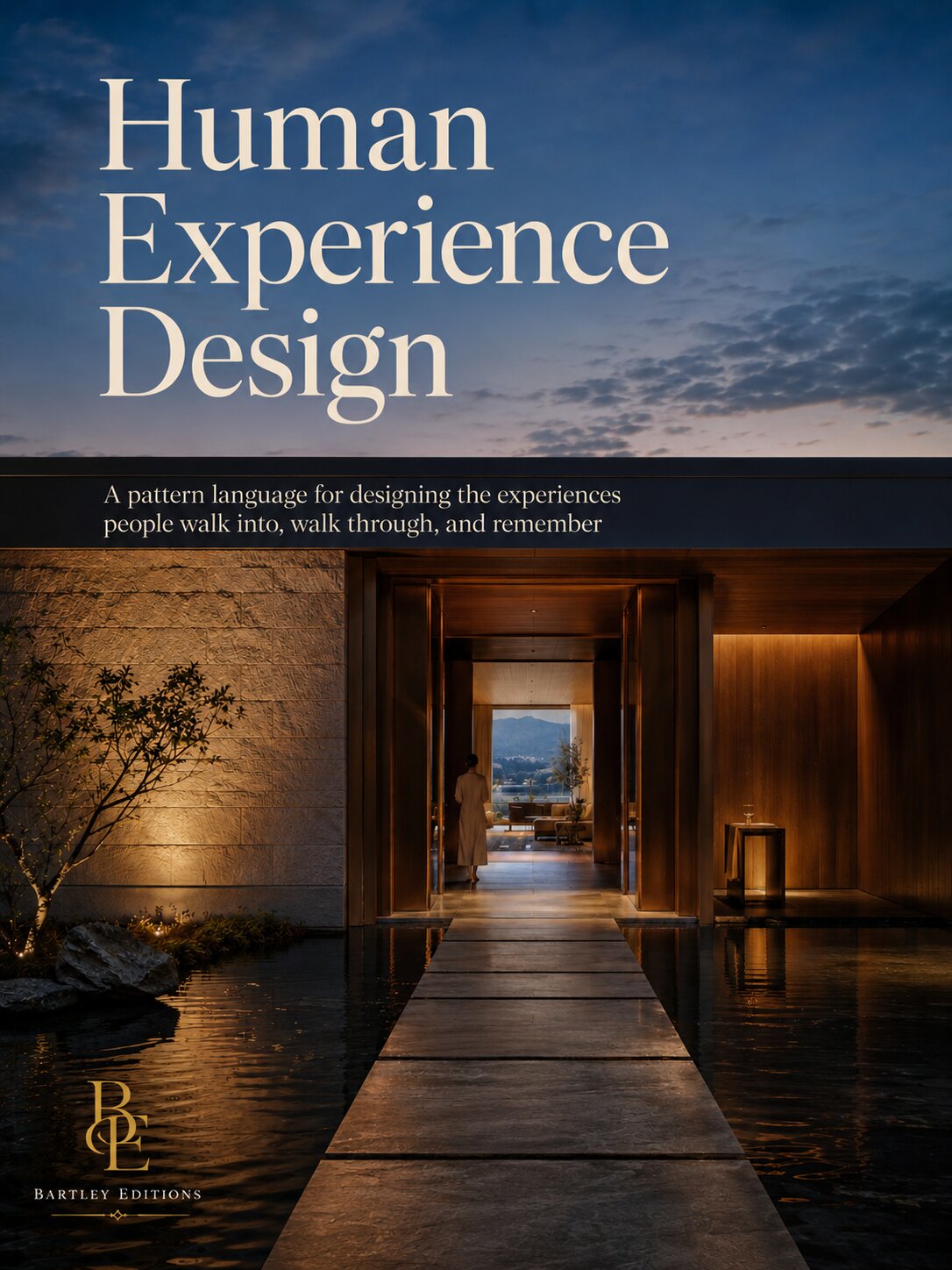
Human Experience Design is a pattern catalog for the deliberate composition of moments a person spends inside a designed environment or service flow — the choreography of arrival, threshold, immersion, peak, ending, and afterimage that determines whether a person remembers the time as worth their time. The book covers experiences staged in physical space (hospitality, retail, museums, themed entertainment, immersive theatre, brand activations) and in service flow (hospitality service rituals, customer experience, the seam between digital and physical channels). It does not cover graphic, screen-only UX as its primary subject — UX is well served by Tidwell, IxDF, Welie, and deceptive.design. This book operates above the screen, treating the interface as one channel among several.
The form is Christopher Alexander’s A Pattern Language and the Gang of Four’s Design Patterns. Each entry is a named pattern, antipattern, or concept with consistent anatomy: context, problem, solution, examples with project credits, sources, and links to related entries. Two book-specific fields — Sensory Channels and Inheres-In — name the modality and the canonical setting each pattern lives in.
Browse the Encyclopedia
Introduction — A person can walk into a place that was expensive, staffed, photographed, and still remember mostly friction. The lobby looks good but gives no first move. The queue moves but drains attention. The reveal lands before the guest is ready. The farewell is polite and forgettable. Human Experience Design is a pattern language for designing the physical and service-based experiences people walk into, walk through, and remember. Includes What’s New, Article Map, and more. View all 2 entries →
Foundations — The vocabulary and theory the rest of the book assumes. The on-ramp. Includes Experience Economy, Activation, Servicescape, Affordance, Attention Restoration Theory, and more. View all 18 entries →
Arrival and Threshold — The patterns of entry: how the guest crosses from the everyday world into the designed one. Includes Threshold of Disbelief, The Driveway, The Vestibule Pause, The Decompression Zone, The Briefing Ritual, and more. View all 9 entries →
Wayfinding and Choreography — The patterns of movement through the space. Includes The Weenie, The Wayfinding Spine, Kinetic Energy, Decision Point Calibration, The Choreographed Beat, and more. View all 5 entries →
Sensory and Atmospheric Design — Sound, scent, light, material, temperature, taste — the multisensory layer of the servicescape, named at the modality level. Includes Sensory Anchor, Sensory Layering, Sensory Congruence, Light as Choreography, The Soundtrack and the Silence, and more. View all 7 entries →
Narrative and Meaning — Story, theme, backstory detail, the Goffmanian frame, suspension of disbelief, narrative transportation, authenticity, place-identity. Includes Backstory Detail, Theme Coherence, Authenticity-Within-Frame, Place-Identity, Symbolic Crossing, and more. View all 6 entries →
Service and Ritual — The staff-guest contact patterns: greeting, recovery, anticipation, farewell, the brand-as-ritual, the named service standard. Includes The Greeting Standard, Anticipatory Service, Service Recovery Theatre, Farewell as Peak, Front-Stage / Back-Stage, and more. View all 6 entries →
Peak, End, and Memory — The architecture of remembering: the peak moment, the ending, the afterimage, the trophy, the ritual artefact, the share-out. Includes Peak-End Composition, The Trophy Artefact, The Shareable Moment, Duration Neglect, and more. View all 4 entries →
Setting-Specific Patterns — Patterns that genuinely do not transpose: the immersive-theatre mask convention, the museum interpretive-label tradition, the themed-entertainment land, the restaurant tasting menu, the experiential flagship store. Includes The Mask Convention, The Interpretive Label, The Themed-Entertainment Land, The Restaurant Tasting Menu, The Experiential Flagship Store, and more. View all 5 entries →
Ethics and Antipatterns — The dark side of the discipline: experience-washing, manipulated urgency, synthetic scarcity, dark patterns at the threshold of physical space, theme-park pastiche, manufactured authenticity, designed exclusion. Includes Experience-Washing, Synthetic Scarcity, Manufactured Authenticity, Theme-Park Pastiche, Sensory Overload, and more. View all 8 entries →